
Secretary of State Mike Pompeo said that countries like India, if it gets the exemption, would be asked to bring down their oil imports from Iran to zero in six months' time.
India's efforts to join the grouping suffered a setback in June when the NSG plenary decided against accepting its membership application after China and some other nations opposed entry of a non- Non-Proliferation Treaty signatory.
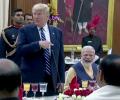
'Many said his visit was very risky. But mercifully, Air Force One has taken off from Delhi without Mr Trump stepping on anybody's toes,' notes Ambassador T P Sreenivasan.

'There is no holistic picture of our own goals and objectives.' 'For some inexplicable reason, the decision makers find it best to listen to their inner souls in dealing with these issues rather devising a carefully thought-out, structured plan,' says Vice Admiral Premvir Das (retd).
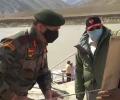
'We should not minimise the seriousness of Chinese encroachments because their perception is different.' 'Nor should we fall into the trap of accepting so-called 'buffer zones' in areas of overlapping claims. We cannot have buffer zones in our own territory,' asserts Ambassador Shyam Saran, a former foreign secretary.

Sebi has asked stock exchanges and other market participants to remain watchful of funds and entities with Iranian links, as the global inter-governmental agency FATF continues to classify Iran as one of the 'high-risk and non-cooperative jurisdictions' with respect to money laundering and terror financing activities.

Both statesmen possess a cultivated pugnacious style which they keep in reserve and can at will bring into play, and despite the mutual distrust in Russian-American relations, they are proponents of detente, quintessentially, who take their mission deadly seriously, points out Ambassador M K Bhadrakumar.

Moon Jae-in's visit will play a crucial role in exploring complementarities between India's Act East policy and South Korea's New Southern policy, says Dr Rahul Mishra.
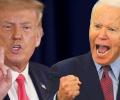
Irrespective of the outcome of Tuesday's keenly-contested US presidential election, America's strategic relationship with India is expected to maintain the current momentum and strengthen further, policy documents and remarks from the two campaigns indicate.

In his pre-departure statement, he said trade ties between India and Russia can increase even further, to benefit not only the two nations but also the world.
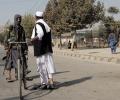
Pakistan would want to take full advantage of the situation to direct Taliban trained terrorists into the Kashmir Valley, alert Lieutenant General Ashok Joshi (retd) and Colonel Anil A Athale (retd).
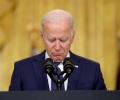
Afghanistan will remain a frontline state for Washington for a foreseeable future in terms of the potential threats to US national security from terrorist groups, asserts Ambassador M K Bhadrakumar, who played a stellar role in beginning India's dealings in Afghanistan in 1994.

The bogey of the 1962 defeat must be laid to rest with a finality that is unquestionable. The myth of Chinese invincibility is a tall tale that belongs to an era gone by, says Vivek Gumaste.

India must also not rule out dialogue with Pakistan. However, talks with Pakistan must be structured, and further progress must be based on visible results.

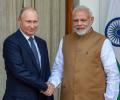
Russian President Vladimir Putin arrived in New Delhi late on Friday night for annual summit talks with Prime Minister Narendra Modi on Thursday that is aimed at building on the already close strategic ties, particularly in the fields of nuclear energy, hydrocarbons and defence.

"Fifteen years ago, I was leading the efforts to approve the historic civil nuclear deal with India. I said that if the US and India became closer friends and partners, then the world will be a safer place," Biden, who was vice-president in the Obama administration, said while addressing the Indian-American community on India's Independence Day.

Director of National Intelligence Dan Coats' remarks came days after a group of Pakistan-based Jaish-e-Mohammad terrorists struck the Sunjuwan Military Camp in Jammu on Saturday, killing seven people including six soldiers.

'Transformation of Ukraine into some kind of permanent strategic challenger, which Russia would have to contain and deter, spend a significant part of political and strategic resources on it.'
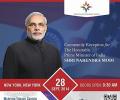
'Unlike Japan and China, the US has a long relationship with India. He is going there to fly the Indian flag in a gesture of friendship. This is a journey like none other, meant to signal that the two democracies are in a defining relationship of the 21st century.'

The reduction of tension on the Chinese border may have reduced the urgency of a Biden-Modi meeting, but the sooner Modi starts a bromance with Biden the better as he had done with Obama and Trump, suggests Ambassador T P Sreenivasan.
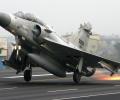
A realistic assessment will tell us that not much has changed between India and Pakistan; the relationship remains as fraught as before with little prospect of reconciliation, notes Ajai Shukla.

'I am not minimising either the seriousness or the complex nature of the current situation.' 'Naturally, we have to do what it takes to secure our borders.' 'We are talking to the Chinese, both through military channels and diplomatic ones.'
'In fact, they work in tandem.' 'When it comes to finding a solution, this must be predicated on honouring all agreements and understandings.' 'And not attempting to alter the status quo unilaterally.'

US ambassador to the UN Nikki Haley also called on all countries to sever economic and diplomatic ties with Pyongyang to curb its nuclear programme.
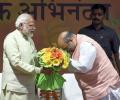
The Bharatiya Janata Party's landslide victory in state polls has "implications" for the Sino-India ties as it could further embolden Prime Minister Narendra Modi's "hard-line attitude" and pose difficulties for "compromises" in rows with countries like China, official Chinese media commented on Thursday.

'When war is thrust on you as in 1962 and 1965 or is tempting as in 1971, ensure that all other fronts are kept quiet, leaving your army free to deal with one,' says Shekhar Gupta.
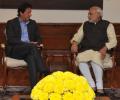
'Any 'de-escalation' that brings down tensions will deprive the BJP of a plank with seamless possibilities to project PM Modi as the 'Iron prime minister' and hype up jingoism in the upcoming election campaign,' notes Ambassador M K Bhadrakumar.
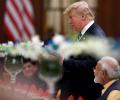
Modi may take satisfaction from his display of considerable political skill in managing a mercurial, temperamental and unpredictable US president and nudging him into uncharacteristic restraint and even carefully orchestrated remarks. This personal chemistry will come in handy if Trump returns as president in the November elections, says former foreign secretary Shyam Saran.

PM Modi seems to be gradually ending India's strategic ambiguity
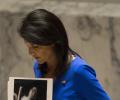
North Korea considers Assad's Syria an ally, so it views Donald Trump's decision to strike Syria as a message to Pyongyang as well.

The prime minister's outreach to Japan is a recognition of the civilisational potential that the two nations hold and can wield in evolving an era of 'Asianism' in global politics, says Anirban Ganguly.

Once again an Indian prime minister has realised that with Pakistan and China, things will not move as he wishes.
CAATSA was aimed at Moscow and not intended to damage the military capabilities of its 'allies and partners', US said.

World leaders are reacting with caution to Donald Trump's jaw-dropping victory in the US presidential election, with some of them reminding him of the democratic values and the global responsibility he carries.

Haley also said there was a plan for her to travel to India by the end of this year.

One thing Beijing must understand is that India is not obsessed with being a threat to China but only wants a rightful place for itself in the world, says Sanjeev Nayyar.

'The military aim in a future conflict, if it can't be avoided, should be to cause maximum damage to the adversary's war waging capability and capture limited amount of territory as a bargaining counter,' says Brigadier Gurmeet Kanwal (retd).

'Progress demands regular senior-level attention from American leaders.' 'A leaders' summit is great, but we need sustained engagement to continue to forge new agreements and find new areas of cooperation.'

The MEA asserted that Arunachal Pradesh was territorially intergal and inalienable to India.

India's doctrinal policy shift in combating terror by carrying out the Balakot air strikes inside Pakistan, appointment of a Chief of Defence Staff and hastening work on military modernisation marked a new beginning in 2019 in dealing with complex security challenges.
'Since each chief single-mindedly pursues his service's interests in the competition for turf and in core matters such as budget share. The CDS, therefore, must act as an "honest broker" whose decisions serve the broader national purpose, rather than narrow service interests,' says Ajai Shukla.
 © 2026 Rediff.com - Advertise with us - Disclaimer - Privacy Policy - Sitemap - Feedback - About us - Terms of use - Grievances